PHILOMATH, Oregon – Miller Timber Services is not your ordinary logging business. For one, the company specializes in cut-to-length timber harvesting and relies exclusively on Ponsse logging machines. However, the company is much more than a logging business.
Miller Timber Services offers a wide range of services and is organized into several affiliated business units under the company umbrella. Operations include cut-to-length timber harvesting, transportation, and reforestation.
It also has a dedicated unit for harvesting operations and other services in mountainous terrain. The mountain services unit specializes in projects like clearing for ski trails and lifts, construction of trails for hiking and biking, and related forest and vegetation management.
Miller Timber Services also specializes in wildland firefighting and emergency services for both private and government lands. The company’s wildland firefighting services span more than three decades. It specializes in 20-person hand crews that respond to wildfires nationwide. The company has provided firefighting services from Alaska to Florida, including most of the West, the Southeast and Mid-Atlantic, and the Great Lakes.
“Our mission is to be the premier forestry services provider for our industry,” said Matt Mattioda, who has the dual title of senior vice president of cut-to-length systems and chief forester. “We offer a full cycle of services, from the stump to the delivered log and everything in between: planting, growing, protecting, thinning, and harvesting, with an eye to leave the forest better than we find it. We have an obligation to future generations to do that.”

Matt Mattioda, senior vice president of cut-to-length systems and chief forester for Miller Timber Services. ‘Our mission is to be the premier forestry services provider for our industry,’ says Mattioda.
The company is owned by its founder, Lee Miller, president and CEO, who is semi-retired. Lee grew up in Oregon, the son of a forester. His family owned and operated a small tree farm and did logging on their own property. He earned a BS degree in forestry engineering from Oregon State University. When he went into business for himself he started with a chainsaw and a pickup truck.
Matt, who also was educated at Oregon State, earning a BS in forest management with a minor in business, has been with Miller Timber Services since 2010. Company leadership includes six other managers.
The company has an office in Philomath, which is located in western Oregon roughly midway between Salem and Eugene, and additional facilities to support and supply operations in the field. Although the company’s headquarters is in Oregon, it is a nationally-based enterprise that does business in other states. It conducts timber harvesting operations throughout the West, notably Washington, Oregon, and California.
Miller Timber Services buys standing timber and also contracts for thinning or timber harvesting services. Clients include Starker Forests, Green Diamond Resource Company, and Hampton Tree Farms, a division of Hampton Lumber. The company also does a lot of work for government agencies.
Dealing with different state regulations can be a challenge, notably California, he added. “The cost structure in California is much higher,” compared to other states. State regulations in Oregon are burdensome, he suggested. “The regulatory environment adds a layer of complexity” that takes a lot of time and energy.

Miller Timber Services has two Ponsse Mammoth forwarders, the manufacturer’s largest model; one was added in 2025.
The company performs only cut-to-length timber harvesting and relies solely on Ponsse machines. It has an assortment of other heavy equipment, notably loaders and road-building equipment.
Miller Timber Services has the largest fleet of Ponsse machines in North America. It has Ponsse Ergo harvesters and a mix of Ponsse forwarders.
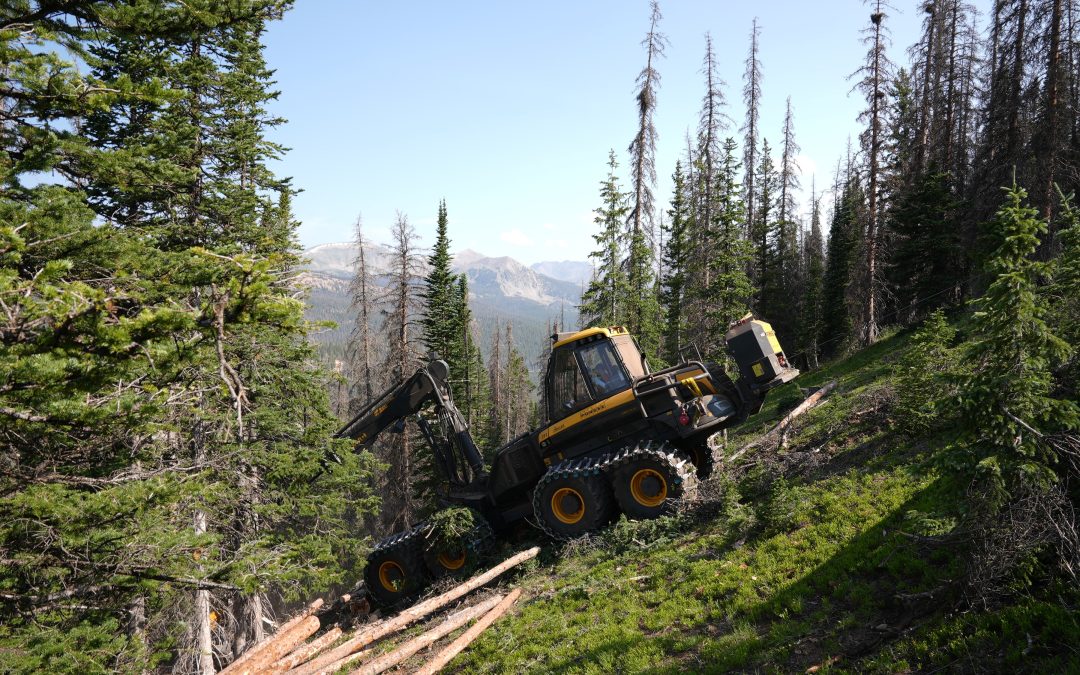
It was the first company to use Ponsse’s tethered logging equipment. Every harvester and forwarder is equipped with the Ponsse winch system. When operating on steep ground, the machines normally are tethered to a stump. “It’s pretty effective,” said Matt.
Although they have been a long-term Ponsse customer, the company has considered other manufacturers of cut-to-length logging equipment at times. They keep staying with Ponsse. “Ponsse is a higher investment,” said Matt, “but the hours you get out of the machines is double” compared to other equipment brands.
Ponsse’s motto is ‘the logger’s best friend,’ added Matt. “They work really hard to achieve that.”
Ponsse is a Finnish business, and its machines are manufactured in Finland. “The partnership we have with them is very important to us,” said Matt. “It’s a family-run business, like us. We can talk directly with the owners.”
Ponsse’s sole focus is manufacturing cut-to-length harvesters and forwarders, he noted. They have no other product. “They have to be very good in order to survive.”
Nonetheless, there are still challenges from time to time. “It’s important to have open, honest relationships with them. That’s how you achieve higher goals.”
Miller Timber Services has two Ponsse Mammoth forwarders, the manufacturer’s largest model; one was added this year. “We saw a need to mix up our machines a little bit and put another one into the rotations,” said Matt. “It’s been a great piece of equipment.”
The Ponsse Mammoth forwarder is made for the most demanding logging sites. It is powered by a Mercedes Benz 295 hp engine and can carry 25 tons of logs. The Mammoth is equipped with the stepless continuously variable transmission (CVT) system and the Ponsse K121 loader. A sturdy frame structure and super-powerful hydraulics ensure that big wood can be transported readily, even in difficult terrain. The stepless gearbox and advanced hydraulics that utilizes two pumps instead of one ensure that ideal torque levels at all times. The frame and power transmission have been designed and synchronized.
(For more information about Ponsse equipment, visit www.ponsse.com.)

Miller Timber Services was the first company to use Ponsse’s tethered logging equipment. Every harvester and forwarder is equipped with the Ponsse winch system. When operating on steep ground, the machines normally are tethered to a stump.
Dealing with only one manufacturer of logging equipment “absolutely” makes operations easier in several respects, agreed Matt, such as training for both operators and mechanics, training for project managers, and ordering and maintaining an inventory of parts. Miller Timber Services has a staff of field mechanics and also relies on Ponsse personnel and their distributors at times.
Miller Timber Services has trucks for hauling wood, but it also has a dedicated fleet that is supplied by J.B. Hunt Transport Services as well as a dedicated fleet of independent truckers. The company is starting its third year with J.B. Hunt, which has a fleet manager-dispatcher embedded with Miller Timber Services.
The company employs mechanics who are embedded with teams operating in the field. The mechanics are equipped with mobile trailers stocked with replacement parts.
The company has a diverse workforce – employees who started out planting trees and moved up to operating equipment or managing operations, college graduates in leadership positions, and employees from other countries. Students from Finland participate in an exchange program, learning to operate equipment and how forestry is conducted in the Western U.S. “That enriches the culture of the organization,” said Matt.
All employees receive on-the-job training. They are taught how to work safely, utilizing proper techniques to protect themselves and others. All employees are required to wear approved protective gear. Regular safety meetings are conducted.
“We operate with a servant style of leadership that allows our people to thrive…and for us to take care of our clients, who actually are our partners,” said Matt. “No one person here is more important than another. It takes a team to make this go.”
Miller Timber Services has a number of employees who have been with the company for a long time, including some who joined the company in the mid-80s and early 90s.
“We’re a team,” said Matt. “We do whatever it takes to get the job done.” Forestry is a dynamic industry, he observed. Projects change according to the terrain and ground conditions, the timber, weather, regulations, and more. “What’s really important is the people and how they can adapt and change and do whatever it takes.” One day a guy may be running a machine, something he’s done for a year, and the next he may be felling oversize timber by hand. Our guys are really adaptable like that. They’re dedicated and flexible.”
“We send a team of folks to do projects,” said Lee, “not just equipment operators. It takes a team to make this thing go,” including office and administrative staff. Saw filers, mechanics, equipment operators, Hunt truck drivers, “They’re all part of our team.”
Although Miller Timber Services has the ability to field 20-plus logging crews, markets have declined, Matt noted. At the time he spoke with TimberLine, the company was working on about eight jobs. “Times are definitely on the harder side, but we’re optimistic by nature.”
The company has not had to lay off any employees. Asked if they have had to adapt, Matt said, “We’re away adapting and changing. It’s a constant evolution. We’re not the same company we were in 2017. In 10 more years we won’t be the same. You adapt and change to remain viable.”
The company is a member of Associated Oregon Loggers and Associated California Loggers. It is also a member and active in the National Wildfire Suppression Association.
Miller Timber Services also is active in research, noted Matt, partnering with Oregon State University, Arizona State University, and Humboldt State University in California, as well as the U.S. Forest Service and its research stations. “We’re trying to move our profession,” said Matt. We want to learn. We want to grow.”
The company also is proactive in promoting forest management. It conducts tours for landowners groups, customers, and others to educate them about healthy forest management practices. “Most of the public has no idea what a healthy active forest looks like,” observed Matt.