STEVENS POINT, Wisconsin – The more we use all our senses, the more we learn. It’s all about getting our hands and minds in sync, and equipment training simulators give a big boost to the learning experience.
Ponsse simulators will be part of the curriculum at the University of Wisconsin-Stevens Point (UWSP) and at select high schools across the Badger State in 2024.
This is a story with many components: college students in natural resources, high school students, workforce enhancement, the American Rescue Plan Act of 2021, Ponsse, and its simulators and engagement efforts. Let’s start with Ponsse, well-known to TimberLine readers as the Finnish manufacturer of cut-to-length logging machines.
Ponsse North America is headquartered in Rhinelander, Wisconsin. Pekka Ruuskanen heads the company’s North American operations. A family-owned company, Ponsse Oy began in 1970 in Vieremä, Finland.
Engagement with customers and communities is an integral part of the Ponsse philosophy. To better train customers and introduce its technology to potential customers and operators, Ponsse uses simulators. The company has four simulator models to educate and train people how to operate Ponsse harvesters and forwarders.
Ponsse simulators have now been deployed for broader use – to enhance educational experiences among college and high school students. The American Rescue Plan Act of 2021, which allotted $19 trillion in funding to invigorate the U.S. workforce imperiled by the COVID pandemic, was a source of funding for the simulators that will be used at UWSP.
Some of the ARPA funding passed through the Wisconsin Department of Workforce Development. Les Werner, a UWSP professor and director of the Wisconsin Forestry Center, and UWSP colleagues sought a forest innovation grant. They were awarded a grant for $8 million.

From left, Ponsse trainer Matt Goddard with Cole Hager, a University of Wisconsin-Stevens Point student, shown with Ponsse Cobra harvester.
The forestry program at the UWSP “creates students that are knowledgeable, skilled and employable,” said Les. The grant funds will augment training for students in the natural resources school, students that include future foresters and a range of professionals from botanists to ecosystem restoration specialists. Funds will also support programs that target high school students, who may have among them future forestry professionals, loggers, as well as mechanics and designers who may develop the next innovative tools for the wood products industry.
When Les spoke with TimberLine in early October, junior and senior college students in timber harvesting and silviculture classes already were benefiting from the simulators, although programs using the simulators were still in development.
“Ponsse, they’ve been absolutely fabulous partners,” said Les. “(The programs incorporating the simulators) wouldn’t have been possible without them.”
Many federal and state grant programs encourage in-kind matches. When Les and his collaborators needed high-quality video equipment to supplement the simulator experience, Ponsse stepped in to help by contributing a 50 percent in-kind match.

Another view shows more of the simulator as Keith Turnquist instructs a student. Ponsse provided a 50-percent in-kind match for a grant for the university, discounting the simulator price by 50 percent, a value of $75,000.
“Ponsse gave us a discounted price for the simulators,” said Les. The discount, valued at $75,000, was used as a match in the request for funds in the grant application. Ponsse also provided a harvester, forwarder, and an operator to assist with a photo shoot. Pictures from the photo shoot will be used for recruitment materials and to advertise the program.
As another significant part of the grant-funded activities, simulators will be taken to high schools across the state and incorporated into curriculum. Les has been traveling to teacher conferences to gauge interest in participation, and interest has been strong. Instructors in applied tracks for high school students “want students to be involved in the physical part” of learning, he explained. Curriculum emphasizes skill development that could lead to entry-level employment following high school.
Les expects the high school programs as well as a six-week immersion program at a UWSP satellite campus both to be up and running in 2024. He is enthusiastic about every dimension of the programs, but particularly about the potential to recruit high-school students to disciplines they might not have considered.
High school students were born in a digital world, and they expect their education experiences to be leading-edge. The Ponsse simulators provide that kind of experience. “Literally getting them used to sitting in a harvester or forwarder” and giving them an “introduction to the mechanics of how the machine operates” nudges students to think in new ways, said Les. It’s where the development of the future workforce begins.
Students who have had the chance to get into the simulators already are positive about their experience. “They have responded very favorably,” said Les, who noted that high school students who are proficient at gaming quickly embrace virtual training.
Joe Salzer, who heads educational outreach-digital services at Ponsse, joined the UWSP Wisconsin Forestry Center project planning in 2022, when it was already underway. He helped bring a Ponsse simulator to a conference for science educators.
“(The simulator) was a big hit,” noted Joe. “The kind of ripples we made were like a stone dropped into a small pond. Not long after, UWSP’s grant was funded, and we’ve been working together closely ever since.”
Ponsse simulators already are being used at Oregon State University and Front Range Community College in Colorado. Moreover, Ponsse is working with several other institutions about how it can be part of their curricula.
It’s important for foresters to be fully immersed in the techniques of loggers, said Joe, and Ponsse “absolutely” understands that. “Manufacturers, foresters, operators, landowners, mills – everyone is a part of the same workflow,” he said. “Cooperation and efficiency can be improved across the industry with broader understanding of the tools and techniques.”
UWSP also will be providing “six-week immersive training” at a satellite campus that is being developed at Northcentral Technical College in Wausau, about 35 miles north of Stevens Point. “We are building a state-of-the-art sawmill,” said Les, at a cost of about $2.6-7 million. The mill with lumber kilns will be part of the satellite campus. The concept is for students to learn by doing.
The training at the satellite campus will serve both regular UWSP students and workforce professionals in Wisconsin – college students and “loggers looking at upscaling or rescaling,” explained Les. (Workforce professionals who complete the course may later transfer credits to a college degree program.)
Les has a long list of academic credentials, including B.S. and M.S degrees in forest management and urban forestry. He holds a Ph.D. in horticulture from the University of Wisconsin. He has practical experience, too. Les worked as a logger, starting out cutting aspen and red pine pulpwood with a chainsaw. He still cuts trees occasionally; he considers the activity “stress relief” and uses the saw that has been his longtime favorite, a Husqvarna. Les also worked as an arborist for 18 years.
“I live in a red pine plantation,” explained Les. He built a timber frame pavilion, framed with red pine lumber and with hemlock and tamarack material for the interior.
To build the pavilion Les rented a Wood-Mizer portable sawmill to make the lumber. “I absolutely love milling work,” said Les. He used a Delta planer to surface the lumber and make tongue and groove material. Les relied on his wife, a medical professional who had no logging experience, to help him move timbers that were up to 6×6 and 18 feet long.
The choice of forestry as an academic discipline was a natural fit for Les. “I have a real fascination with biology, the physiology of how trees grow. I get a chance to manage an ecosystem.”
Red pine is the top conifer for timber production in Wisconsin. In recent years, however, pinecone production from red pine trees has been disappointing. To collect as many seeds as possible, the Wisconsin Department of Natural Resources launched a red pine pinecone buying initiative in September. The agency will pay $125 per bushel for pine cones that are properly collected (requirements include separation by county of origin). One bushel yields about a half-pound of seeds. (More information about the initiative is available on the agency’s website, www.dnr.wisconsin.gov.)
The multi-part program that UWSP is developing for high school students is meant to be replicated. “We want the program to be open access,” said Les. He views it as a way to help ensure a sustained and engaged forest products industry workforce for the future, a vision that Ponsse shares.
The UWSP college of natural resources offers degrees in all areas of natural resource management, including programs in ecosystem restoration and management, forest management, forest recreation, and urban and community forestry. All four programs are accredited by the Society of American Foresters.
“We do a remarkable job,” said Les.

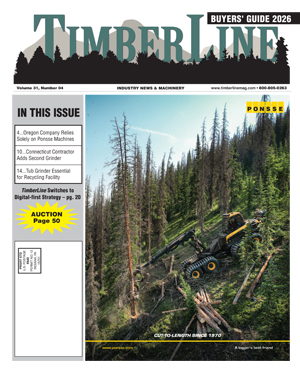
Ponsse provided a harvester, forwarder, and an operator to assist with a photo shoot. Images from the photo shoot will be used in the university’s recruitment materials and to advertise the program.